Beetles
The Beetles are four identical unmanned interstellar probes—John, Paul, George, and Ringo—that serve as the Hail Mary's only communication link to Earth. Designed by the Canadian engineer Steve Hatch and his team at the University of British Columbia, each beetle is a compact, self-contained spacecraft built to carry scientific data across the twelve light-years back to Earth. They are named after the Beatles, a choice that reflects Hatch's personal enthusiasm: he calls the test version "Pete" after Pete Best, the band's drummer before Ringo, and explains that the four aboard the Hail Mary are named John, Paul, George, and Ringo. The beetles are stored in the nose of the Hail Mary, each in its own cubby, and are intended to be launched after the crew completes its research at Tau Ceti.
Design and Capabilities
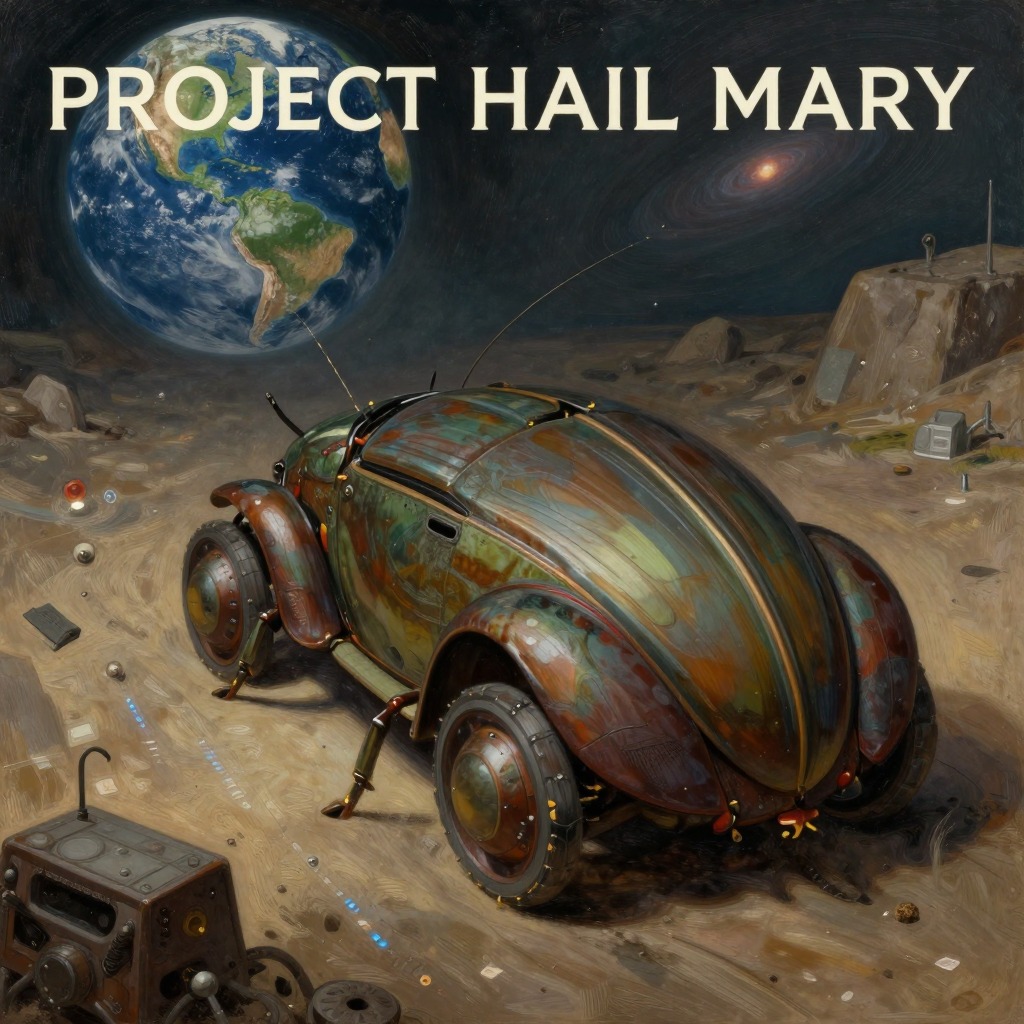
Each beetle is a bulbous, oblong shape with a pointed head and a trapezoidal rear section. The trapezoid houses a spin drive—the same Astrophage-based propulsion technology used by the Hail Mary—while the bulbous portion contains 120 kilograms of Astrophage fuel. The head contains a computer with 5 terabytes of functioning memory and a radio transmitter. The beetles are designed to accelerate at five hundred g's until they reach a cruising speed of 0.93 times the speed of light, which means they experience only about twenty months of subjective time during the twelve-year journey back to Earth. They navigate by identifying constellations with visible-light cameras and use reaction wheels for attitude control. Once within radio range of Earth, they broadcast their location and await instructions from the Deep Space Network. Hatch built four beetles for redundancy, reasoning that only one needs to survive the trip.
Role in the Mission
Ryland Grace discovers the beetles on the Hail Mary's control-room screens shortly after waking from his coma. He immediately understands their purpose: they are the only way to send information back to Earth. The beetles are stored in the nose of the ship, and Grace later learns that he can upload data to them via external drives mounted in the lab. The launch command is a simple button on the Beetles panel, and the probes orient themselves autonomously toward Earth. After Grace and Rocky discover Taumoeba—a microbe that preys on Astrophage—and breed a nitrogen-resistant strain that can survive on Venus, Grace modifies the beetles. He installs mini-farms on each beetle: small steel capsules containing a Taumoeba colony, a Venus-like atmosphere, and a coil of Astrophage-filled tubing to sustain the microbes during the journey. He also refuels the beetles, using the Hail Mary's remaining Astrophage supply, and launches all four toward Earth. The beetles carry not only the Taumoeba samples but also a USB stick full of data and findings, ensuring that even if the Hail Mary is lost, Earth will receive the solution.
Narrative and Thematic Significance
The beetles embody the mission's fundamental tension between hope and sacrifice. They are the only part of the Hail Mary designed to return, yet they carry no crew—only data. Grace's decision to launch them before turning back to rescue Rocky means he knowingly forfeits his own chance to return home, accepting that he will die on Erid. The beetles thus become a symbol of the mission's success: they carry the solution that will save Earth, even as Grace himself remains stranded. Their names, drawn from the Beatles, add a layer of human warmth and cultural specificity to an otherwise purely technical object, and Hatch's exuberant personality—his optimism about Astrophage as a clean energy source, his love of puns—makes the beetles feel like a personal gift from one human to another across the vastness of space.